
Flagship civic-tech case study

Há Combustível

A community-powered civic platform mapping fuel availability in real time during Mozambique’s 2026 fuel crisis.

Live snapshot

What made it work

4,689+community reports
2cities covered
0cost to the user

Overview

Community intelligence, turned into immediate public value

Há Combustível was launched in April 2026 during a national fuel shortage to help people quickly understand which stations had fuel, which had queues, and which were empty.

Instead of requiring a dedicated app, the platform was designed to work directly in the browser, making it fast to access, easy to share, and realistic for people operating with limited time, bandwidth, or device constraints.

The project demonstrates the type of low-cost, high-utility civic technology that Nowledge wants to build: simple enough to be used immediately, but robust enough to generate collective intelligence in moments of pressure.
Why it matters

Key characteristics

Bilingual PT/EN access for a broader community
No app install required
Built around community reports instead of centralized data collection only
Replicable model for other essential public services

Crisis data snapshot

What the platform revealed during the fuel crisis

The Há Combustível data report turns collaborative reporting into a clear picture of how the crisis unfolded across Maputo and Matola.

4,689community reports

Collected between April 14–23, 2026

10days of monitoring

A compressed real-time crisis window

20brands monitored

Across stations tracked by the community

30+neighbourhoods covered

Maputo and Matola

48%reports with queue

Showing how widespread waiting times became

37 minaverage wait time

Based on community-reported conditions

Peak of the crisis

April 15–16 was the hardest moment

Scarcity peaked on April 15–16, when 50–53% of reports described queues and only 19–20% of stations were reported as available.

Fuel type

Petrol was more scarce than diesel

Among reports with identified fuel type, petrol accounted for 55.7% of reports, confirming that it was the most constrained fuel during the crisis window.

Geography

Some neighbourhoods were hit much harder

Boane had the highest empty rate at 47%, followed by Aeroporto at 45% and Polana Caniço at 39% among neighbourhoods with at least 20 reports.

Normalisation

Conditions improved quickly after the peak

The empty rate dropped from 28% in phase 1 to 18% in phase 2, while availability rose from 22% to 39%; by April 23, 76% of reports were marked available.

Impact model

What this case study proves

Civic technology

Public value at speed

A focused digital product can reduce uncertainty and improve decision-making for thousands of people during a fast-moving public challenge.

Community signal

Collective reporting works

People will contribute data when the tool is useful, lightweight, and clearly designed to solve a shared problem.

Nowledge model

Practical intelligence in action

The platform embodies Nowledge’s operating philosophy: accessible technology, contextual data, and intelligence that helps people act in the present.

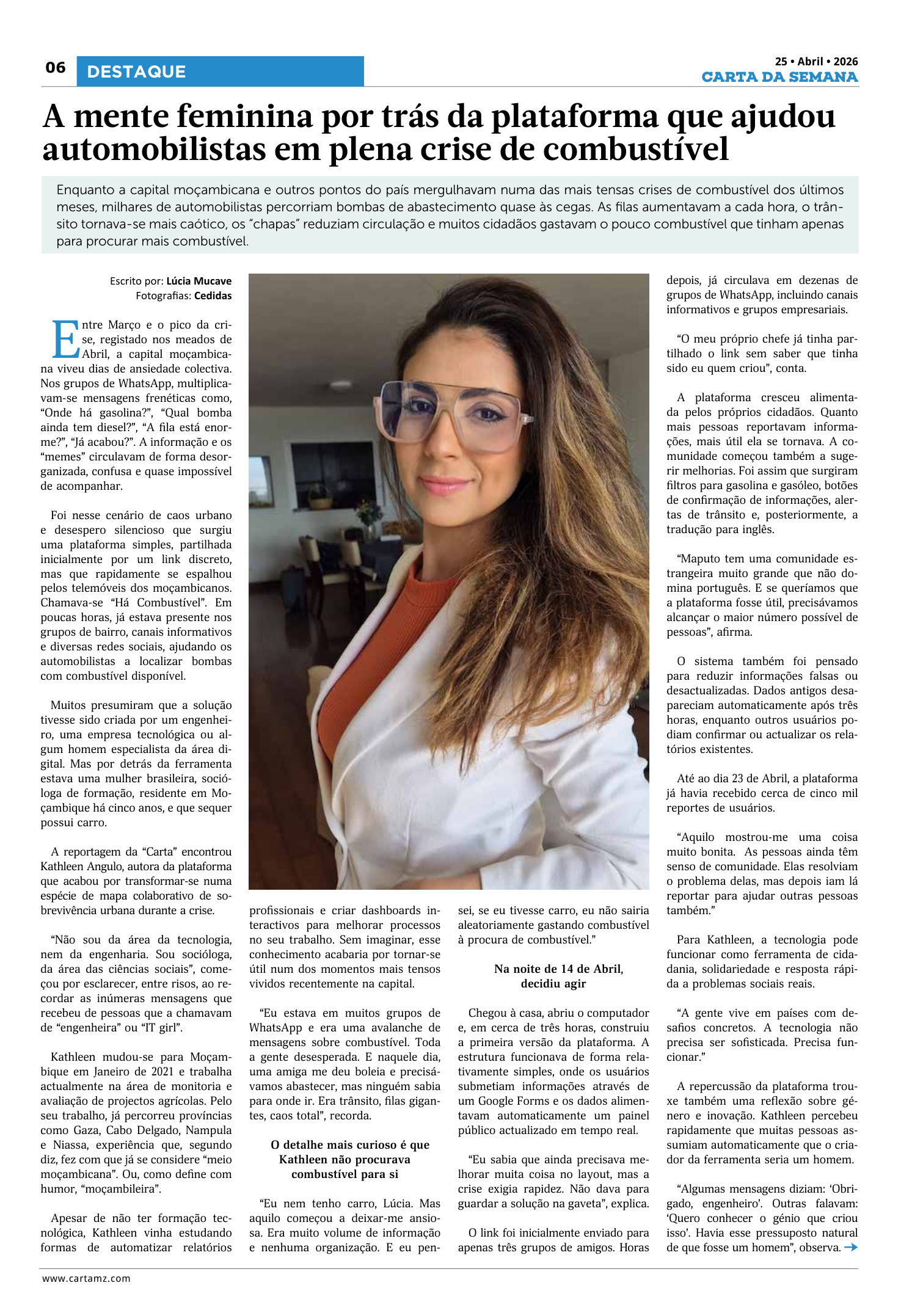
The woman behind the platform that helped motorists during the fuel crisis

Press & recognition

Carta da Semana25 April 2026

Featured in Carta da Semana

The platform and its creator, Kathleen Angulo, were profiled by Carta da Semana in a feature story about the role Há Combustível played during Mozambique’s fuel crisis.

The woman behind the platform that helped motorists during the fuel crisis